
Woman Down by Colleen Hoover
Woman Down
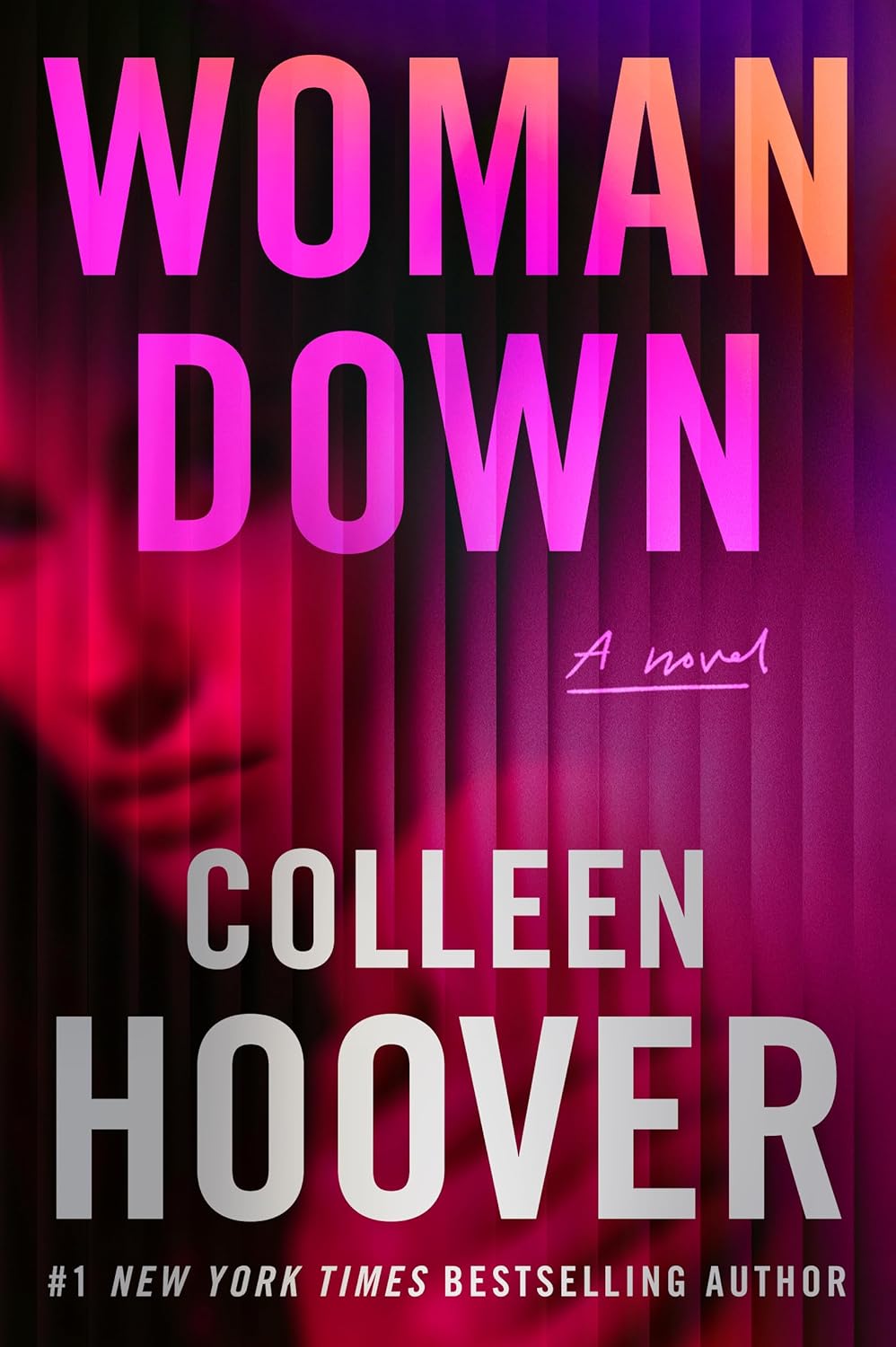
The saddest thing about Woman Down is not what it is. It's what it was this close to being. A novel about a woman who loses the line between her fiction and her life, written by an author who may have been doing exactly the same thing, and who pulled back at the last moment from saying it out loud.
— Between the Wines Book Club ·
Book Overview
Summary
W oman Down follows Petra Rose, a bestselling author whose career has been publicly unraveling for a year after a controversial film adaptation of her novel ignited a cancel culture firestorm. Humiliated, blocked creatively, and hemorrhaging money, she retreats to a remote lakeside cabin to write the book that might save her mortgage and her sanity.
On her first night there, police lights wake her at 5 a.m. A tall, devastating officer named Detective Nathaniel Saint knocks on her door to report that a man has died by suicide on her road. He's professional. He's married. He has the kind of face you don't forget. And Petra, whose book-in-progress is about a married cop who begins an affair with a witness named Reya, becomes convinced she has just found her muse.
"She came here to write a story. She ended up living one instead."
What begins as "research" spirals into something far more dangerous. Saint visits. They kiss. He role-plays scenes from her book sometimes blurring the line between fiction and reality in ways that terrify and thrill her simultaneously. There's a car date in the next town over. A staged break-in that leaves Petra tied to a chair in the dark. A night in the shower where forgiveness happens in ways it probably shouldn't.
Then cracks appear. There is no record of the suicide in the local paper. The townspeople have never heard of Saint. The neighbor Mari, who Petra trusted, confesses she was paid to play along. And a background search reveals: there is no Detective Nathaniel Saint. The man Petra has been sleeping with is Eric Kingston a screenwriter from Los Angeles who has been following her live streams for years, who showed up with fake police lights and a fabricated identity because, in Petra's own words during a public Q&A, she said she would "do anything to be a better writer."
The confrontation is terrifying, morally disorienting, and leaves Petra fleeing the cabin in the rain heartbroken, furious, exposed, and somehow holding the bones of the best book she's ever written.
The Players
Character Analysis
Petra Rose
Protagonist · Author
The most layered character in the book. Petra is a woman in full-on imposter syndrome crisis, she has written 43 books, been on the cover of People, and still believes every negative review over every five-star one. She is funny, chaotic, self-aware, deeply private, her readers don't even know her real last name is Andrews, that she's married, or that she has children. Her moral compass doesn't disappear during the affair, it just gets suffocated by her hunger for experience, for feeling something real to write from. She is not a villain. She is a deeply human mess, and that's what makes her so readable.
"Not a villain. Just a woman who wanted to feel something."Saint / Eric Kingston
The Man at the Door · Antagonist
For three-quarters of the novel he is the perfect dark romance hero: brooding, possessive, protective, perceptive. He tells Petra she's a great writer before her husband does. And then the last act tears that apart he is a man who stalked a woman across the internet, planted fake police lights, impersonated a cop, and used her own publicly stated desires to justify it all.
"He made you feel the same ambivalence Petra did."Shephard
Petra's Husband
Not a villain, but not a hero either. He is the portrait of a partnership that has calcified, he measures Petra in royalties, shows up at her writing retreat without warning, and hasn't fought for her in years. He loves her in the way that habit looks like love from the outside.
"Habit dressed up as love."Nora
Best Friend · Co-host
The Greek chorus of this book. She is outrageous, protective, and honest to the point of rudeness. She never knows about Saint, which is exactly the point, Petra can't tell the one person who would actually tell her the truth.
"The one person who would've stopped this. Never got the chance."Mari Longsetter
Neighbor · Accomplice
The orange-haired, silk-dress-wearing neighbor is one of the best supporting characters Hoover has written in years. She is loud, lonely, chaotic, surprisingly wise, and ultimately complicit. Her confession scene is devastating precisely because she doesn't think she did anything that wrong — and she might be partially right.
"The best character who made the worst choice."Where It Happens
Locations & Settings
The Lake Cabin
Northern California
The primary setting. Originally booked on the lake's west side for sunset views (Petra's ritual), she ends up in a newly remodeled east-facing cabin that feels more like a tech startup than a writer's retreat — polished concrete floors, recessed lighting, sterile modern furniture. The cabin's unsettling modernity mirrors Petra's state of mind: everything looks clean and put-together on the surface, but there's no warmth.
The Blue Lantern
The Next Town Over
A low-lit bar where Petra and Saint go on their car-date disguise. They eat takeout burgers and French fries in Petra's car in the parking lot afterward, dipping into shared ketchup with extra salt. The scene where Reya and Cam dissolve briefly, and Saint tells Petra about his brother's arm, and they start to feel like real people to each other.
The Empty Road
Open Air · Dawn
One of the book's most charged scenes happens on the hood of Petra's car, on an empty county road at dawn, after Saint catches her following him home. The open-air setting — completely exposed, morning light, Saint pinning her between his arms — is one of the more daring and uncomfortable scenes in the book.
The Lake & The Boat
On the Water · Chapter 17
Where Saint reveals that his marriage is actually a separation — that he and his wife haven't lived together in six months after failed IVF. The lake also gives us the iconic Mari-snorkeling moment, which is the funniest and most absurd scene in the book.
Petra's Home
Sacramento, California
Brief but pivotal — Chloe's birthday party, the suburb, the cul-de-sac normalcy. The place that represents everything Saint could destroy. Saint parks under the oak trees at the end of the street and watches. It's the moment where the book tips from exhilarating into genuinely unsettling.
Literary Travel
Book Trail 🗺️
Places inspired by or connected to the world of Woman Down. For when you want to live the story a little too literally.
Lake Tahoe & Sierra Nevada
California
The unnamed lake in the book closely matches the geography, cabin culture, and isolated road systems of Tahoe's less-traveled eastern shores. Drive the back roads off Highway 50 for full Petra energy.
Vibe: writer in crisis, suspicious neighbors, bad decisions in beautiful places
Sacramento
California
Petra's home. The city she calls "a giant noisy concrete hug I never asked for." Suburban neighborhoods, cul-de-sac birthday parties, and the weight of ordinary life.
Vibe: everything you're running from, waiting for you at home
Los Angeles
California
Where Eric Kingston actually lives. The world of screenwriters, NDAs, and the entertainment industry that Petra knows from her adaptation experience. A city of people performing versions of themselves.
Vibe: everyone has a false identity and a LinkedIn profile
Any Lakeside Café
Wherever You Are
For your writing retreat chapters. Bring your laptop, order something strong, and stare dramatically at the water. You don't need a saint. You need a deadline and a good playlist.
Vibe: main character energy, unfinished manuscript, zero regrets
Did You Know
Fun Facts 🎉
FACT 01
📖Woman Down originated as a short story called "Saint" published in The One More Step anthology, which has since been unpublished. Hoover spent three years expanding it into a full novel.
FACT 02
🎬Hoover's author note specifically asks readers not to draw parallels between Petra's situation — an author dealing with adaptation backlash — and her own life. Make of that what you will.
FACT 03
✍️Petra's pen name uses only her first and middle name. Her last name, Andrews, is never known to readers — the same level of privacy Hoover herself maintained for years online.
FACT 04
🕵️Saint's fake name, Nathaniel Saint, is the kind of name Petra herself says "belongs in one of my books." Eric Kingston chose it specifically knowing it would appeal to her. It was never an accident.
FACT 05
📝The book's title, Woman Down, is invented by Petra herself — mid-panic, while Saint confronts her in the bedroom. She realizes it perfectly describes both her life and Reya's trajectory.
FACT 06
🎭Mari's actress résumé includes hanging upside down in a simulated car wreck for eight hours a day while filming an I Survived episode. She considers it her most professional work to date.
For the Meeting
What to Drink & Eat 🍷🍽️
🍷 Drink Pairings
For the cabin writing chapters
Sauvignon Blanc
Literally what Petra orders at the Blue Lantern — "something light and crisp." A New Zealand Sauvignon Blanc (Marlborough region) with its sharp, clean bite perfectly matches Petra's state of mind: restless, precise, and a little dangerous.
For the affair arc
Old Fashioned
Saint's drink of choice. Whiskey, bitters, orange peel — sophisticated on the surface, complicated underneath, and it hits harder than you expect. Order one when you're discussing Saint's true identity reveal.
For the book club discussion
Rosé with Edge
Something between Petra's soft exterior and her messy interior. A Provençal rosé with enough structure to hold up to the conversation — because this book will generate a conversation.
For the ending
A Second Glass of Whatever
Because you'll need it.
Trust us on this one.🍽️ Food Pairings
Main course
Lasagna
The most emotionally loaded food scene in the book. Saint shows up after the house confrontation and has made Petra lasagna from scratch — rich, slow-cooked, meticulous. It's the moment Petra almost forgives him. Almost stays. Make it for book club night.
Warning: may cause complicated feelings.Snack
Brownies (not the special kind)
Mari brings Petra a tin of brownies when she arrives. She specifically clarifies: "Not the special kind. Sorry." Bring classic fudgy brownies. Label them accordingly.
Side
Cheeseburger & Salty Fries
The Blue Lantern car-date order. No tomatoes. Lots of extra salt poured directly onto the ketchup. Comfort food for uncomfortable situations.
Dessert
Yogurt (one cup, one spoon, shared)
The snack Petra and Mari end up passing between them. Low-key chaotic. Very on-brand for their entire relationship.
Dress the Part
What to Wear 👗
This book has a very specific aesthetic: lakeside chaos, writer-in-exile energy, morally grey with excellent taste in wine. Pick your character.
Outfit One
The Petra
A sundress that could pass as "I wasn't trying" but absolutely was. Bare feet or simple sandals. Minimal mascara. Hair half-up in a messy bun that took 20 minutes. Carry a tote bag with a book in it even if you don't need one.
Energy: "I'm here for the writing, not the drama" (she is here for both)
Outfit Two
The Mari
A silk maxi dress with a wild print, chunky jewelry, and a color choice that makes people slightly uncomfortable. Arrive 10 minutes late. Bring mimosas in a Yeti cup. Offer no explanation for either.
Energy: morally flexible, artistically inspired, completely unregretful
Outfit Three
The Nora
Effortlessly cool. Something you'd wear on a late-night live stream that reads "I didn't try but I look incredible." Willing to say what no one else will say at the table. Always.
Energy: your best friend who will absolutely judge you and also love you for it
Accessories Required
- 🪪 A business card with a fake name on it
- 🍷 A glass of whatever Petra was drinking
- 📖 A book you're using as a prop, not reading
- ✨ The audacity
For the Discussion
Book Club Questions 📚
The novel opens with a podcast tearing apart a fictional author. Before we even meet Petra, we're handed a verdict on her. How did that choice affect your sympathy for her going into the story?
Petra says she believes negative reviews over positive ones, "as if the negative comments hold more truth." Is this specific to artists, or a universal human tendency? Have you ever experienced it yourself?
Did you find Petra likable? Does likability matter for a narrator like her?
Petra frames the relationship with Saint as "research." At what point, if any, did you stop believing that framing — and do you think Petra ever truly believed it herself?
Saint consistently blurs the line between playing "Cam" and being himself. Do you think he ever genuinely stepped out of character, or was the whole thing a performance from start to finish?
The break-in scene (Chapters 9–10) is one of the most polarizing in the book. How did you feel reading it? Did the aftermath — Saint making tea, Petra forgiving him — feel earned, disturbing, or both?
Hoover gives Petra several moments to leave — to stop answering texts, to not open the door, to call the police. Why do you think she doesn't? Is it weakness, loneliness, ambition, or something else?
Shephard is not a villain, but he is not blameless either. How much responsibility does the marriage dynamic carry for what Petra does?
The book raises an interesting question about private vs. public identity. Petra keeps her last name, her marriage, her children completely off her author brand. Saint calls this a form of lying. Is he wrong?
The window scene in Chapter 15 is one of the most morally complex moments in the book. What did you make of Petra's reaction — and of your own?
When you found out Saint was Eric Kingston, did it change how you felt about everything that happened before? Does deception retroactively alter the meaning of a connection?
Saint argues he was giving Petra exactly what she asked for in her live videos. Is there any version of that argument that holds weight, or is it purely manipulation?
Mari accepts money to participate in Saint's deception. How complicit is she? Does her explanation — "I made sure he didn't kill you before I took the money" — justify anything at all?
The novel Petra is writing mirrors her real life so precisely it becomes impossible to separate them. Do you think Hoover is making a commentary about how all fiction is autobiographical?
At the end, Saint tells Petra to dedicate the book to him. If she finishes Woman Down (the book within the book), what do you think she does — dedicate it, tell Shephard, or go home and pretend nothing happened?
Nora never finds out about Saint. If Petra eventually tells her the whole truth, what does Nora say?
Major spoilers below — finish the book before reading this section
Full Breakdown
Spoilers
The Big Reveal
Saint Is Not a Detective
His name is Eric Kingston, a screenwriter from Los Angeles. There was no suicide, no police chase — he staged it all with fake police lights. He had been watching Petra's live streams and online Q&As for years. When she said publicly, "I would do anything to be a better writer," he took that as an invitation. He drove hours to a remote lake, planted lights in the road, knocked on her door in character, and never broke. Not once. Until she found his LinkedIn.
The Neighbor
The Mari Betrayal
Mari witnessed Saint setting up the fake lights the very first night and confronted him. He paid her to stay quiet and play along. She accepted because she was bored, found him attractive, and convinced herself it was a harmless artistic prank. Her confession to Petra is devastating precisely because she doesn't think she did anything that wrong — and a small part of the reader wonders if she's partially right.
The Relationship
Saint Was Never Married
The wedding ring, the wife's calls, the guilt — all theater. He was married, but separated six months prior after failed IVF revealed he was infertile. He tells Petra this on the boat as a confession of vulnerability. Knowing now that even this could have been partly constructed makes every emotional scene before it feel different on re-read.
Chapter 15
The Window Scene
While Petra is in bed with Shephard, Saint appears outside the bedroom window — completely still, watching. It is simultaneously one of the most transgressive and most discussed scenes in the book. Hoover makes no effort to redeem it narratively. It happens. Petra has complicated feelings about it. The reader is left to sit with their own.
How It Ends
The Escape — And the Open Door
Petra packs in a frenzy. Saint confronts her. He insists she asked for all of this. He kisses her — she pushes him away and runs to her car in the rain. She grabs her laptop — the manuscript — before she leaves. She drives. We never know if she tells Shephard. We never see her arrive anywhere. The ending is deliberately, frustratingly open.
What We Would Change
About Woman Down
The premise is brilliant. A blocked writer who uses an affair as research and loses control of the line between fiction and reality, that is an incredible novel waiting to happen. Here's why it didn't fully get there, and how it could have.
Colleen Hoover never decided what book she wanted to write. Thriller, dark romance, and cultural critique — all three are here. None reach their logical conclusion.
Saint Needed to Be a Real Threat
The reveal that Eric Kingston is a stalker who staged an entire elaborate deception should be terrifying. But Hoover never commits to that. In the same chapter where Petra discovers the truth, he kisses her and she feels warmth in her stomach. The narrative wants to be a dark psychological thriller and a satisfying dark romance at the same time — and it ends up being neither, fully.
A stalker who represents no real consequence is not an antagonist. He's a plot device in a romantic costume.
The fix: He recorded everything. He has videos of Petra. He threatens to send them to Shephard if she leaves. Now Petra has to actively escape — not just choose to walk away when she feels like it. Real stakes. Real terror. Real story.
Petra's Arc Runs in Circles
For twenty-plus chapters, Petra does the exact same thing: she discovers something alarming about Saint, gets scared, forgives him, resets. No permanent change. No growth. The cycle is exhausting by chapter fifteen — and it's still running at chapter twenty-five.
A protagonist who never changes isn't flawed — she's static. And static characters don't earn their endings, open or otherwise.
The fix: Mari's confession arrives at chapter 15 — the midpoint — not the end. Now Petra has to make decisions with real information. She can no longer pretend she doesn't know. Every choice after that carries actual weight.
Shephard Needed to Be a Real Person
The husband exists as an obstacle, not a character. Hoover wants us to feel that Petra's marriage is genuinely dead — but she never shows us when it was alive. We don't know what Petra is risking because we've never seen what she had.
Without that, the affair carries no moral weight. Petra isn't betraying a person. She's betraying a contract. And those don't hurt the same way.
The fix: One flashback scene — Shephard at his best, the version of him Petra married — early in the book. That's all it takes. Now when she opens the door for Saint, the reader feels what she's walking away from. That tension is the whole novel.
Chapter 15 Needed Consequences
A man stands outside your bedroom window while you're in bed with your husband — watching. It is the most transgressive moment in the book, and also the most narratively irresponsible one. Petra processes it internally and moves on. Nothing changes. That is not tension. That is evasion.
The fix: Shephard almost sees him. That near-miss becomes the moment Petra can no longer compartmentalize. It forces the confrontation — with Saint, with herself, with her marriage — that the book keeps delaying. The window scene should be the point of no return. Not a footnote.
Mari Deserved Alternating Chapters
Mari Longsetter is the most alive character in the book. She has more personality in three scenes than Petra has in twenty. The orange hair, the silk dresses, the "not the special kind, sorry" brownies — she is the chaotic, wise, complicated presence this novel needed more of. And she appears in roughly 20% of the pages.
The fix: Mari narrates alternating chapters. She sees everything from the outside. She has her own arc — why she took Saint's money, what watching this unfold does to her own loneliness, what she owes Petra. Her perspective would have given the novel depth, comedy at the right moments, and a moral counterpoint the single-narrator structure couldn't sustain alone.
An Open Ending Needs a Closed Arc
Petra packs. She runs in the rain. She grabs her laptop. She drives. And the book leaves open the possibility that she goes back to the cabin. That image — a woman in a car in the rain with her manuscript — is beautiful. But it is not an ending. It is a fade out.
An ambiguous ending only works when the character has changed before the story closes. Petra exits the book exactly as she entered it: confused, without real limits, dependent on external experience to feel something to write from. Nothing landed.
The fix: She tells Nora. Not the whole truth — but enough. That one conversation, Petra choosing to let someone who loves her actually see her, would be the change the whole novel was building toward. Keep the open ending. Just give her one decision that costs something first.
The Meta-Fiction Promised More Than It Delivered
The book-within-the-book — Petra's novel about Reya and Cam — had extraordinary potential. There were moments where the reader genuinely couldn't tell where Petra's fiction ended and her reality began. That blurring is the most sophisticated thing Hoover attempted here. And she abandoned it halfway through in favor of moving the plot forward.
The fix: Include actual pages from Petra's manuscript intercalated throughout the novel — formatted differently, in italics, as chapter excerpts. Let the reader experience exactly what Petra is experiencing: the confusion of not knowing which version of the story is true. That device, fully committed to, would have made Woman Down unforgettable.

Her Last Breath

You May Also Like

Reminders of HIM
May 11, 2023
Counterfeit Luxury Wannabes
May 11, 2023