Unmasking the Revenge: Analyzing Dear Debbie
Dear Debbie

Dear Debbie
by Freida McFadden
The Secrets Behind the Suburban Smile: A Deep Dive into Dear Debbie

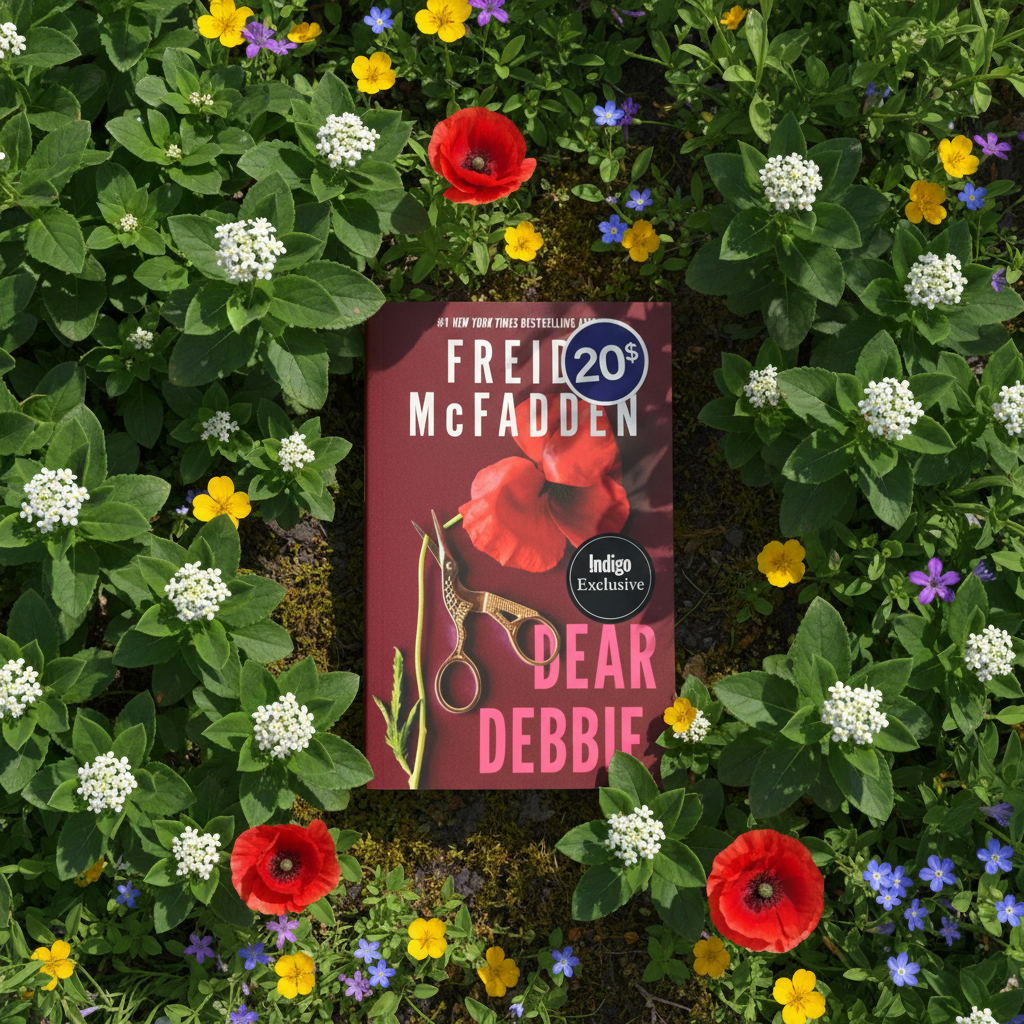
If you’ve ever looked at a perfectly manicured lawn and wondered what’s buried underneath, Freida McFadden’s January 2026 release, Dear Debbie, is the mirror you aren’t sure you want to look into. A standalone psychological thriller FREIDA MCFADDEN, it arrives with the kind of momentum only McFadden can generate — and it does not disappoint.
As a writer who has devoured McFadden’s previous work, I found this novel to be a masterclass in the “unreliable housewife” trope. It’s a chilling exploration of how the societal pressure to “have it all” can turn a sharp mind into a blunt instrument for vengeance. But Dear Debbie is more than just another domestic thriller. It is, at its core, a story about women who have been ignored, minimized, and violated — and what happens when they finally, spectacularly, stop being polite about it.
Debbie Mullen is losing it. For years, she compiled her best advice into her column, Dear Debbie, where the wives of New England came for sympathy and neighborly guidance. Through her work, she heard from countless women who were ignored, belittled, or even abused by their husbands. And Debbie did her best to guide them in the right direction. Or at least, she did. But by the time the novel opens, the carefully cultivated life Debbie has tended like that prize-winning garden of hers, is showing cracks in the soil.
Debbie is completely unhinged in the best way. She is, as one critic put it, “a nontraditional antihero for the ages… gleefully sadistic, gloriously gratifying revenge fiction.” McFadden has always had a gift for making you root for women who probably shouldn’t be rooted for, and Debbie Mullen is her most compelling creation since Millie in The Housemaid. McFadden has created a complex and clever antihero who possesses a fierce charisma, and the reader will find themselves hooked by Debbie’s story from beginning to startling conclusion.
What sets this novel apart from McFadden’s earlier work is how deliberately it dissects the performative nature of suburban womanhood the book clubs, the garden shoots, the breakfast routines, the tracking apps quietly installed on a husband’s phone. Every domestic detail is a grenade with the pin already pulled.
Book Summary
The Premise: More Than Just Advice
The story centers on Debbie Mullen, a woman who wears many hats: devoted housewife, mother of two, and the anonymous voice behind the cheery “Dear Debbie” advice column. But the “Dear Debbie” we see in print is a far cry from the woman writing discarded drafts in the dark—drafts where she suggests her readers solve their domestic disputes with cold-blooded violence.
The Plot: A House of Cards in Hingham
The narrative is a high-speed collision of three perspectives:
- Debbie: The “perfect” mom navigating suburban warfare.
- Cooper: Her husband, an accountant hiding a crumbling career and a burgeoning drinking problem.
- Harley Sibbern: Debbie’s trainer and “friend,” who is secretly sleeping with a man she thinks is Cooper.
The Sabotage Begins When Debbie’s life starts to fray—losing a garden feature to her neighbor Jo Dolan and being fired from her newspaper job—her response isn’t a glass of chardonnay. It’s chemical warfare. She sabotages Jo’s garden and serves avocado-laced sandwiches to her book club, knowing full well Harley is allergic.
The Darker Undercurrents Personal stakes skyrocket when Debbie discovers her daughter, Izzy, is being body-shamed by a coach, and her other daughter, Lexi, is being blackmailed with “revenge porn” by a toxic boyfriend. This triggered a visceral reaction in me as a reader; McFadden expertly connects Debbie’s current rage to a buried trauma—her own college sexual assault by a man named Hutch.
The Core Themes
The heart of this thriller beats with the Danger of Secrecy. Every character is wearing a mask; Cooper hides his unemployment while Debbie tends to a “pharmaceutical” garden of opium flowers. Beyond the suspense, McFadden weaves in a biting commentary on Misogyny and Societal Control, from Coach Pike’s surveillance of the girls’ locker room to the suffocating expectations of the suburban elite. Ultimately, it is a story about the Lasting Effects of Trauma, showing that the past isn’t dead—it’s just waiting for a catalyst to explode.
The Twisted Climax (Spoilers Ahead!)
In a classic McFadden “gotcha” moment, we learn that the man Harley is sleeping with isn’t Cooper at all—it’s his coworker, Jesse Hutchinson.
For Debbie, this is the ultimate convergence of past and present. Jesse is “Hutch,” her rapist from years ago. Debbie doesn’t just get mad; she gets clinical. She steals Jesse’s gun, uses it to execute Cooper’s boss (who had also wronged her), and frames Jesse for the murder.
Personal Take: The brilliance of this ending isn’t just the revenge—it’s the chilling pragmatism. Debbie manages to “save” her marriage and her family’s reputation by cleaning up everyone’s messes with a blood-stained broom.
Final Thoughts
One year later, the Mullens are in “happy” couples’ counseling. Cooper has his own firm, and Debbie has launched a successful app. On the surface, they are the American Dream. But the final secret—that Debbie killed a man to help a friend she met through her column—reminds us that Debbie isn’t just a survivor. She’s the predator you never see coming.
Character Analysis
Debbie Mullen: The Vigilante Housewife
Debbie is the quintessential “unreliable narrator.” On the surface, she’s a “t-shirt-and-yoga-pants” mom in her mid-forties, sporting a neat ponytail and a pleasant, “girl-next-door” face. But this branding is a calculated mask. A former MIT computer science standout once dubbed “the next Bill Gates,” Debbie stifles her high-functioning intellect in a suburban life that she increasingly finds “empty.”
When she loses her advice column, she doesn’t just snap; she recalibrates. Debbie justifies her descent into stalking, framing, and murder as a logical byproduct of having a 178 IQ with no outlet. However, her true “why” is rooted in unprocessed trauma. It’s revealed that Debbie dropped out of college after being raped by a man named “Hutch.” Her subsequent “accidents” involving the misogynistic Coach Pike, the predatory Zane, and the financial abuser Ken Bryant are less about boredom and more about a buried, desperate need for justice. By the end, her moral compass is grey at best; while she spares one life, she remains chillingly unrepentant about the others.
Cooper Mullen: The Secretive Spouse
Cooper is the “boy-next-door” counterpart to Debbie—an accountant in his late forties who appears to be the perfect, loyal husband. For much of the book, he serves as a massive red herring; his late nights and hushed phone calls lead the reader (and Harley) to believe he’s having an affair.
The reality is a different kind of betrayal: The Danger of Secrecy. Cooper has hidden a 20-year struggle with alcohol dependency, terrified that admitting his “weakness” would cause Debbie to lose respect for him. While he loves his wife, the novel hints at his failures as a partner; he is often self-absorbed, failing to notice the glaring red flags of Debbie’s deteriorating mental state because he is too focused on how her “lapses” in housework affect him.
Harley Sibbern: The Delusional Antagonist
Harley is the “cool” friend Debbie always wanted—pierced, edgy, and self-assured. But Harley’s friendship is a total fabrication. She only befriended Debbie to “pump her for information” about the man she believes is Cooper.
Harley is a tragic figure defined by a desperate, almost delusional need for a stable relationship. Despite a history of dating married men that “rarely end well,” she convinces herself that “Cooper” (who is actually Jesse in disguise) truly loves her. Her competitiveness and willingness to hurt Debbie—taking “exhilarating” pleasure in Debbie finding “Cooper’s” shirt in her apartment—ultimately leads to her fatal confrontation with the real Mullen family.
Jesse Hutchinson (“Hutch”): The Predator in Plain Sight
Jesse is the connective tissue of the novel’s trauma. To Cooper, he’s a gym buddy; to Harley, he’s a sexy boyfriend; to Debbie, he is “Hutch,” the man who raped her and derailed her life.
Jesse embodies a terrifying, casual misogyny. He views his history of drugging women and sexual assault as “no big deal,” displaying a total lack of remorse or empathy. He is a predator who uses his “sexy” and “in-shape” appearance to move through the world undetected. His death in prison at the hands of other inmates serves as a final, brutal closing of the circle Debbie started.
Zane: The Modern Misogynist
Lexi’s boyfriend, Zane, represents the “entry-level” version of Jesse’s toxicity. He is characterized by a lack of consideration—honking instead of knocking, leaving the toilet seat up, and “smirking” at authority.
His behavior escalates from immaturity to criminal exploitation when he attempts to use revenge porn to coerce Lexi into sex. This specific brand of control triggers Debbie’s protective instincts and her own past trauma. While he ends the novel as a “victim” of a car crash, Debbie views his downfall not as a tragedy, but as a necessary cleaning of the social slate.
Location Trail
Where Debbie goes at night
Freida McFadden · Dear Debbie · 2026
⚠ Full spoilersThe setting is deliberately specific. The novel is set in suburban Massachusetts and one location is named explicitly in the plot summary we’ve been working from Hingham, where Debbie’s newspaper, the Hingham Household, is based. Here’s the full breakdown:
Hingham, Massachusetts — The primary setting. A real town on the South Shore of Boston, about 18 miles southeast of the city. It’s an affluent, historic coastal suburb exactly the kind of place where manicured gardens, book clubs, and competitive neighbours make perfect sense. Debbie’s home, Jo Dolan’s home, Coach Pike’s house, Ken Bryant’s house, the abandoned park where she drugs Zane, and the Hingham Household newspaper are all here.
Boston / Greater Boston area — Debbie was originally an MIT computer science major before her suburban life, tying the novel’s backstory firmly to the Boston metro area. Cooper’s accounting firm and the gym where Harley trains would plausibly be somewhere in this orbit too.
New England (broadly) Debbie’s column serves the wives of New England, giving the novel a wider regional identity even as the action stays hyper-local to one suburb.
So in short: it’s essentially a one-town book. The claustrophobia of Hingham everyone knowing everyone, the same gym, the same book club, neighbours you can see from your garden is what makes Debbie’s revenge so intimate and so dangerous.
Suspect Map: The Hidden World of Hingham
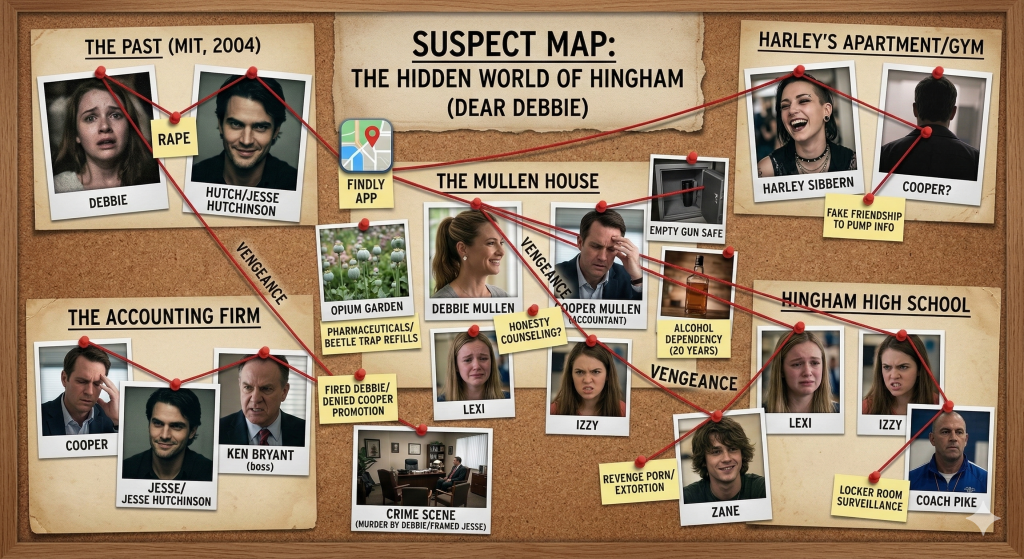
Suspect Map Analysis: The Hidden World of Hingham
This map traces the real connections that defy the sunny suburban facade presented by the Mullen family. You can see how the image visually organizes the intricate web described above.
The Past: The Catalyst (Image 0: Top Left) The core of the map is the connection between “THE PAST (MIT, 2004)” and the present. Grainy photos of a young, terrified DEBBIE are linked with a young, arrogant “HUTCH.” This connection is labeled “RAPE.”
Debbie Mullen: The Center of Vengeance (Image 0: Center) Debbie sits at the center of the Mullen House, linked to her “FINDLY APP” (visualized as a digital map). From her photo, red strings of “VENGEANCE” extend to multiple targets:
Connection to Ken Bryant (Image 0: Center Left): A string showing Debbie using Jesse’s gun to Murder him and Frame Jesse.
Connection to Zane (Image 0: Bottom Right): A connection labeled “DRUGGING/REVENGE PORN” showing Debbie deleting the evidence.
Cooper Mullen: The Red Herring (Image 0: Center Right) Cooper’s map reveals his own hidden world. His connection is to a bottle labeled “ALCOHOL DEPENDENCY (20 YEARS).” This secret creates the Red Herring that distracted Harley, making her think his hushed phone calls were an affair.
Harley Sibbern: The Delusional Intersection (Image 0: Top Right) Harley’s apartment is where the Big Lie lives. She is shown laughing, connected to a man seen only from the back (labeled “COOPER?”). This man is Jesse. This connection is linked to a note reading “FAUX RELATIONSHIP/HARLEY’S DELUSION,” showing she is sleeping with Jesse, convinced he is Cooper, and using her fake friendship with Debbie (labeled “FAKE FRIENDSHIP/PUMP INFO”) to gather intel.
Jesse Hutchinson: The True Identity Exposed (Image 0: Top/Center Left) Jesse is the apex suspect. The red strings visually reveal that HUTCH (the rapist) and JESSE (the coworker) and “COOPER” (Harley’s lover) are all the SAME PERSON. This dual life connects the entire map: the Past, the Accounting Firm, Harley’s apartment, and Debbie’s buried secret.
This map traces the real connections that defy the sunny suburban facade presented by the Mullen family.
1. The Mullen House (The Source of Secrets)
Debbie: Initially seen as a suburban victim, she is the Catalyst for Vengeance. The map shows connections from her past trauma directly to her targets. She uses her “Findly” App (intelligence masked as control) to monitor the entire map.
Connection to Jo Dolan: Sabotage (Opium garden vs. beetle traps).
Connection to Ken Bryant: Murder (Using Jesse’s gun).
Connection to Zane: Drugging & Destruction of Evidence (Deleted revenge porn).
2. The Accounting Firm (The Economic Core)
Cooper: He seems centered here, but the firm is where his facade crumbles.
Connection to Ken Bryant (Boss): Hidden Debt and a denied promotion, providing a motive for Cooper (the perfect red herring).
Connection to Jesse Hutchinson (Coworker): Colleagues/Red Herring. It’s the perfect place for them to swap lives.
3. Harley’s Gym/Apartment (The Intersection of Lies)
Harley: The hub of dangerous romantic delusions.
Connection to “Cooper” (Jesse): Affair/The Big Lie. She is sleeping with Jesse, convinced he is Cooper Mullen, while using her friendship with Debbie to gather intel.
Connection to Debbie: Fake Friendship built on deceit.
4. The School Locker Rooms (The Site of Exploitation)
Lexi & Izzy: The victims whose pain triggers Debbie’s rage.
Connection to Coach Pike: Sexual Harassment/Voyeurism. (Coach arrested after surveillance footage found).
Connection to Zane: Sexual Exploitation/Revenge Porn.
5. The Past (The Ultimate Truth)
“Hutch” (Jesse Hutchinson): The apex of the suspect map. He is the original Rapist of Debbie. His dual life connects the Accounting Firm (as Jesse), Harley’s apartment (as “Cooper”), and Debbie’s buried past.
Into the letters
In Dear Debbie, the advice letters aren’t just filler—they are the heartbeat of the story. As someone who spends my days crafting narratives, I found these letters to be the most brilliant part of the book’s structure. They provide a window into Debbie’s fractured psyche that the standard narration just can’t reach.
Here is a breakdown of how these letters function, woven with my own take on why they work so well.
The Duality of the “Dear Debbie” Format
McFadden uses a three-tier system for these letters. First, we get the reader’s grievance—usually a relatable, “white-picket-fence” problem. Then, we get the Published Response, which is all sunshine, rainbows, and useless platitudes. Finally, we get the Discarded Draft, where the “Real Debbie” comes out to play.
The Philosophy of Sabotage Early on, there’s a letter about a neighbor dispute. While the published column suggests “finding common ground,” Debbie’s private draft is a literal manual on how to destroy a reputation. To me, this felt like the first real warning sign. It’s not just anger; it’s precision. She treats social sabotage like a coding problem—find the bug, delete the source. This is where her MIT background really shines through in the writing.
Power and the “Toxic Boss” The letters concerning workplace dynamics hit differently. One draft suggests that “if a man takes your livelihood, you should take his life.” In my opinion, this is the most honest Debbie ever gets. She sees the world as a zero-sum game. When she eventually executes Ken Bryant, she isn’t just committing a crime; she’s “answering” a letter in the most permanent way possible.
The “Hidden” Confessional
I’ve always believed that every writer leaves a piece of their darkest self on the page, and Debbie is the ultimate example. The column is her confessional booth. Since she can’t tell Cooper about her trauma or her 178 IQ, she pours that “screaming for stimulation” energy into these violent drafts.
The Intelligence Gap: Debbie argues that her spree is just “what happens when somebody has an IQ of 178 and no job.” Personally, I think this is a brilliant bit of self-delusion. She uses her intellect as a shield to avoid admitting she’s simply hurting.
The Cindy Connection: The biggest twist for me was learning that the letter that got Debbie fired was actually the catalyst for her final act of “kindness.” She didn’t just kill Ken for herself; she did it for her reader, Cindy. It turns the “Advice Columnist” trope on its head—she stopped giving advice and started providing results.
My Take: The Disappearing Line
The most effective part of this device is how the line between “Draft” and “Reality” eventually vanishes. By the end of the book, the letters stop. Why? Because Debbie is no longer fantasizing.
I’ve often thought that the “Dear Debbie” column was actually her “training wheels” for becoming a vigilante. She spent years practicing how to ruin lives on paper, so when Jesse (Hutch) reappeared, she already had the “code” written. She just had to hit “run.”
🌸 The Flowers & Plants of Debbie Mullen's Garden
Confirmed in the book
Opium Poppy (Papaver somniferum) The crown jewel of Debbie’s secret garden. The specific name somniferum means “sleep-bringing,” referring to the sedative properties of its alkaloids, which include morphine, codeine, and thebaine. It is legal to grow Papaver somniferum in the United States for garden and seed production purposes the grey area Debbie exploits perfectly.
Rose (Rosa spp.) Jo Dolan’s prized roses, not Debbie’s. Jo’s rose garden is swarmed by Japanese beetles using the trap refills Debbie plants nearby, ruining her stolen photo shoot. The roses are the collateral damage, and the weapon.
Likely in Debbie’s garden the pharmaceutical shelf
Foxglove (Digitalis purpurea) A stunning cottage garden staple with tall purple spires, and the source of digoxin, used to treat heart failure. Perfectly at home in a New England garden and utterly deadly in the wrong dose. The foxglove species Digitalis purpurea is the source of digoxin, a medication used to treat chronic heart failure and to stop a heart entirely if misused.
Belladonna / Deadly Nightshade (Atropa belladonna) All parts of the plant are pain-relieving, antispasmodic, hallucinogenic, narcotic, and sedative, containing tropane alkaloids. A plant that could sedate, disorient, or kill a perfect fit for Debbie’s purposes.
Valerian (Valeriana officinalis) Pretty white flower clusters above ground, powerful sedative root below. Valerian root has been used from time immemorial to treat restlessness, sleep disorders, and insomnia, and has been mixed with other botanicals to induce potent, hypnotic sleep. A natural companion to Debbie’s poppies.
Henbane (Hyoscyamus niger) One of the classic witches’ herbs. It was said that even smelling the flowers would cause sleep, and it contains scopolamine, hyoscyamine, and atropine used historically as a sedative and painkiller.
Passionflower (Passiflora incarnata) A climbing vine with extraordinary blooms, well-suited to New England summers. Passionflowers have become exceedingly popular as ornamental plants due to their beautiful flowers and contain compounds used as mild sedatives and anxiolytics.
Chamomile (Matricaria chamomilla) The most innocent-looking plant on this list. Dainty white daisies, mild sedative, perfect for the neighbour who accepts tea from Debbie without a second thought.
Lavender (Lavandula angustifolia) Lavender acts as an effective sleep aid and has analgesic and antidepressant properties and is exactly the kind of thing a Home Gardening shoot would photograph approvingly, hiding the darker plants behind it.
Wild Lettuce (Lactuca virosa) The milky sap of wild lettuce, known as lactucarium, was traditionally used for its mild sedative and pain-relieving effects, and herbalists sometimes used it to ease coughs, promote sleep, and calm nervous tension. Discreet, unglamorous, and very hard to identify in a well-tended bed.










THEMES
When I was reading through the core themes of Dear Debbie, it struck me how McFadden uses the “perfect suburban life” as a mask for some incredibly heavy issues. As someone who appreciates a story with actual depth, I wanted to re-frame these themes to reflect how they actually hit me while reading.
The “Secret for a Secret” Trap
To me, the most heartbreaking—and frustrating—part of the Mullen marriage is how secrecy becomes a currency. It’s not just that they’re lying; it’s that they use each other’s perceived dishonesty to justify their own.
I kept noticing this loop: Debbie suspects Cooper is hiding something (which he is—his 20-year struggle with alcohol), so she tells herself, “Why should I tell the truth when he’s been lying to my face?” Meanwhile, Cooper feels the “distance” Debbie is creating with her own secrets and uses that as an excuse to keep his sponsorship and meetings under wraps.
It’s a foundational issue where the passage of time makes the truth even scarier. They both admit that the longer they waited, the more they feared the other would be “furious” not just about the secret, but about the decades of silence. It makes you realize that in a relationship, a secret isn’t just a lie—it’s a wall that gets thicker every year you don’t tear it down.
The Policing of Women’s Bodies
This was the part of the book that made my blood boil. McFadden doesn’t just focus on Debbie’s past; she shows how this toxic culture starts in girlhood.
Take Izzy’s soccer coach, Pike. The way he describes teenage girls as an “eyeful” meant to “make the crowd happy” is revolting. He didn’t cut Izzy because of her skill; he cut her because she didn’t fit his “aesthetic” for what a female athlete should look like. Then you have Lexi dealing with Zane’s revenge porn threats. At seventeen, she already intuitively knows that society will blame her for being exploited.
It really highlighted for me that whether it’s a predatory coach, a toxic boyfriend, or the trauma Debbie faced at MIT, the world of Dear Debbie is one where women’s bodies are constantly being policed, judged, or used as a way to exert control.
Trauma: The Unseen Architect
I’ve always felt that trauma isn’t just an event; it’s a ghost that redesigns your entire life. Debbie was “the next Bill Gates,” a computer science genius who was thriving until she was raped. That one event didn’t just hurt her; it derailed her academic career and forced her to spend decades wondering “what could have been.”
Even years later, you see the physical and mental triggers. When that neighbor at book club condescendingly mentions she “never went to college,” Debbie’s face turns pink and she can only protest weakly. It’s a physical manifestation of that old wound being poked.
By the end, I felt like Debbie’s vigilante streak was her way of finally taking the steering wheel back from her trauma. She moves from a place of “shame” to a place of “defense.” While she finally finds some closure by telling Cooper the truth, that final line of hers—vowing to defend herself no matter what—shows that once you’ve been hurt like that, you never truly feel “safe” again. You just get better at fighting back.
Here is the complete Theme Map for Dear Debbie, visualizing the blueprint I described above. I designed it to look like a messy investigation board, showing how the three core themes function like interlocking gears.
As you can see, the image (Image 2) perfectly captures the conceptual breakdown:
Gear 1: Secrecy (The Dagger)
Visualized: A dark, fragmented gear labeled “THE DANGER OF SECRECY” with “LIE FOR A LIE” logic. A red string links Debbie and Cooper, showing their “DECADES OF SILENCE” as they navigate this dangerous logic.
Gear 2: Misogyny (The Ongoing Trigger)
Visualized: A jagged, spiked red gear labeled “SOCIETAL CONTROL.” This gear “locks in” with trauma. You see photos of both IZZY and LEXI with notes showing “COACH PIKE’S HARASSMENT” and “ZANE’S REVENGE PORN EXTORTION.” These ongoing threats are the current sparks that demand a violent reaction.
Gear 3: Trauma (The Original Catalyst)
Visualized: A shadowed purple gear labeled “LASTING TRAUMA.” This is the foundation that drives everything. I contrasted “YOUNG DEBBIE (MIT/GENIUS)” vs. “OLDER DEBBIE (HOUSEWIFE/LOSER?)” to show how the rape derailed her life. The final line of the map shows her vow: “I will defend myself. ALWAYS.”
The Intersecting Core: The Mullen Marriage All these dark forces collide in the center, labeled “THE ‘PERFECT’ SUBURBAN LIFE.” This intersection, visualized as a cracked glass reflecting a polite “ponytail mom” image, is what actually powers Debbie’s actions. When the gears spin, the perfect life cracks, and a red arrow labeled “BLUEPRINTS FOR VENGEANCE” points directly to a handwritten, violent draft of a “DEAR DEBBIE” advice letter. This, to me, perfectly captures how the book’s themes aren’t separate; they create the mechanism for Debbie Mullen to exact her vengeance.
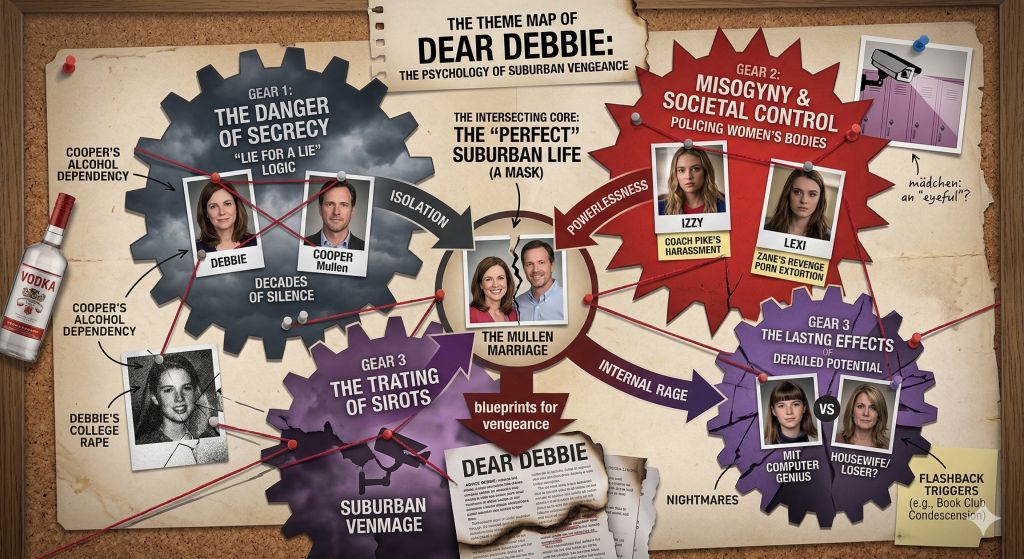
Visualizing the Blueprint of Vengeance: The Dear Debbie Theme Map
This map isn’t just a summary; it’s a blueprint showing how the book’s core themes—Secrecy, Misogyny/Control, and Trauma—don’t just coexist. They collide, creating the “perfect storm” that transforms Debbie Mullen from a mild-mannered advice columnist into a clinical executioner.
Here is a visual breakdown of how these forces interact in her life.
The Intersecting Forces of Dear Debbie
The provided image uses three intersecting colored gears to symbolize how these themes lock together and drive the narrative forward.
GEAR 1: TRAUMA (The Catalyst)
Visually: A fragmented, dark purple gear, labeled “TRAUMA.”
My Interpretation: This represents the base layer of Debbie’s life. The trauma of her college rape didn’t just hurt her; it derailed her future as a computer science genius. The gear is fragmented because it represents broken potential. It drives everything. The arrows show how this primary force feeds into the need for secrecy and the impulse to fight control.
GEAR 2: MISOGYNY & CONTROL (The Ongoing Trigger)
Visually: A spiked, jagged red gear, labeled “MISOGYNY & CONTROL.”
My Interpretation: This represents the current threats in Debbie’s life—the misogynistic world thatpolices women’s bodies. This gear “locks in” with trauma. When her daughters are exploited by Coach Pike or Zane, it’s not just a contemporary issue; it triggers the raw “Trauma” gear, making her reaction explosive. It is the abrasive force that demands a violent solution.
GEAR 3: SECRECY (The Protective Shield)
Visually: A dark, clouded grey gear, labeled “SECRECY.”
My Interpretation: This gear represents Debbie’s defense mechanism. She hides her intelligence, her “opium garden,” and her trauma from everyone, including Cooper. It intersects with “Control”—because she feels controlled by societal expectations (the “perfect housewife” mask)—and with “Trauma”—because she is too ashamed to speak. Secrecy is the mechanism that allows her to build her vengeance in private.
The Intersection: Suburbia’s Dirty Mirror
The center where all three gears meet is labeled “THE ‘PERFECT’ SUBURBAN LIFE.” This intersection is visualized as a cracked glass reflecting a polite “ponytail mom” (Debbie’s public face) while revealing the true dark, intricate machinery behind it. This, to me, is the entire book in a single image: the sunny suburban facade is the byproduct of these dark, interlocking forces. When the gears spin, the “perfect life” cracks, revealing the vigilante waiting beneath.
Let's get some drinks and... food!!
When I was reading Dear Debbie, I was struck by how effectively Freida McFadden uses physical objects—especially food—as a weapon of domestic warfare. In a book defined by secrets and poison, a standard wine pairing simply wouldn’t cut it.
I’ve designed three distinct drink pairings that mirror the central narrative conflicts and themes, focusing on the concepts of “Sabotage,” “Secrecy,” and “Vengeance.”
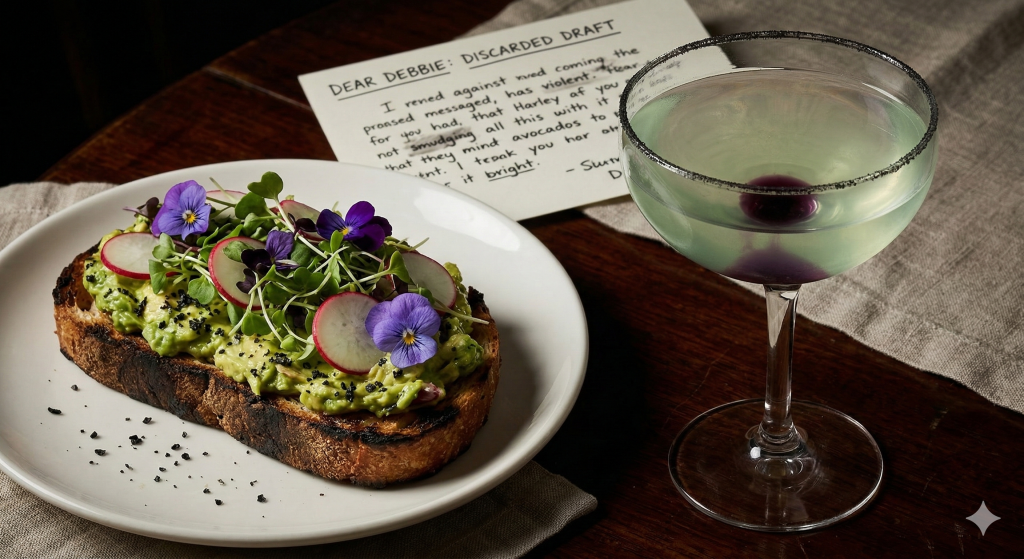
Pairing 1: The “Hingham Household” Sabotage
This pairing is a direct visual reference to the book club scene. It highlights Debbie’s calculated domestic warfare against her “friend” and trainer, Harley.
The Food: “Artisanal” Avocado Sandwiches This is a sophisticated, open-faced tartine served on thick, charred sourdough bread. It features creamy, smashed avocado topped with vibrant microgreens, thinly sliced radish “scales,” a sprinkle of black sea salt, and edible purple micro-flowers. It is beautiful, trendy, and completely malicious, as Debbie knows Harley is allergic.
The Drink: The Poisoned Pen (A “Dear Debbie” Cocktail) A sophisticated, elegant cocktail served in a vintage coupé glass. The base is an “Innocent Gin” mixed with fresh cucumber juice, simple syrup, and lime. The twist is a single, dramatic drop of violet liqueur (Crème de Violette) that rests at the bottom, creating a deceptive, beautiful purple bruise in the otherwise clear drink. It symbolizes the dark heart hidden beneath the “Dear Debbie” column.
The provided image captures this pairing, which is defined by “Domestic Malice.” As described, the artisanal avocado sandwich (Image 4) is served on thick, charred sourdough, topped with vibrant radish and microgreens, and features those malicious purple micro-flowers that Debbie uses to poison Harley.
The “Poisoned Pen” (Image 4) is equally deceptive. It’s served in a vintage coupé, holding a clear gin, cucumber, and lime cocktail. The key is the single, dramatic heavy drop of violet liqueur (Crème de Violette) resting at the bottom of the glass. In the low light of the mahogany table, this creates a beautiful, dark bruise effect in the liquid, symbolizing the dark drafts hidden beneath Debbie’s public advice.
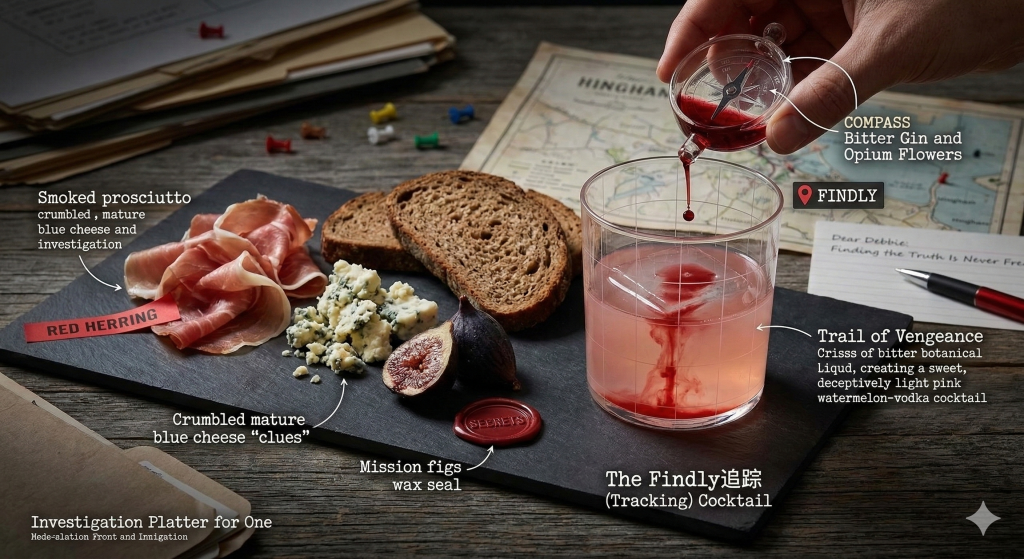
Pairing 2: The “Findly” App Investigation
This pairing focuses on the conceptual theme of “Investigations and Red Herrings,” mirroring Cooper’s search for the truth about his wife, and Harley’s tragic, delusional investigation into “Cooper’s” (Jesse’s) identity.
The Food: “Missing Person” Investigation Platter A sophisticated, modern “platter for one,” served on a slate board textured like an investigation file. It features three components that signify Cooper’s fragmented understanding:
Thinly sliced, smoked prosciutto “red herrings.”
Crumbled blue cheese “clues” (crumbles of clues).
A small pile of dark, mission figs “secrets” (dense, sweet, hidden).
The Drink: The Findly (The “Tracking” Cocktail) Served in a clear, modern glass designed like a map grid. The base is an “Honest Vodka” and fresh watermelon juice, creating a deceptively light and cheerful pink liquid. The key is the presentation: it is served with a small, stylized glass “Compass” (labeled “FINDLY”) containing “Bitter Gin” and “Opium Flowers” (bitter botanical notes, representing the toxicity Debbie hides). The drinker is meant to “track” the sweet watermelon base by adding drops from the bitter compass, creating a crimson “Trail of Vengeance” in the glass. It symbolizes the tracking app that forces the truth to light.
The second pairing, as seen in the image, visualizes the book’s central “Investigation and Clues.” The “Investigation Platter” is served on a slate file board and is meticulously constructed with smoked prosciutto “red herrings” (with the actual red tape!), blue cheese “clues,” and mission fig “secrets.” It looks like a messy investigation desk.
“The Findly is equally specific. It is a sweet, light pink watermelon-vodka cocktail served in a modern, map-grid glass. The unique element is the stylized “COMPASS” containing Bitter Gin and Opium Flowers. The image shows this compass being held, and a drop of the crimson liquid is falling into the glass, creating that crimson “Trail of Vengeance” that is sweet but ultimately poisoned by the truth.
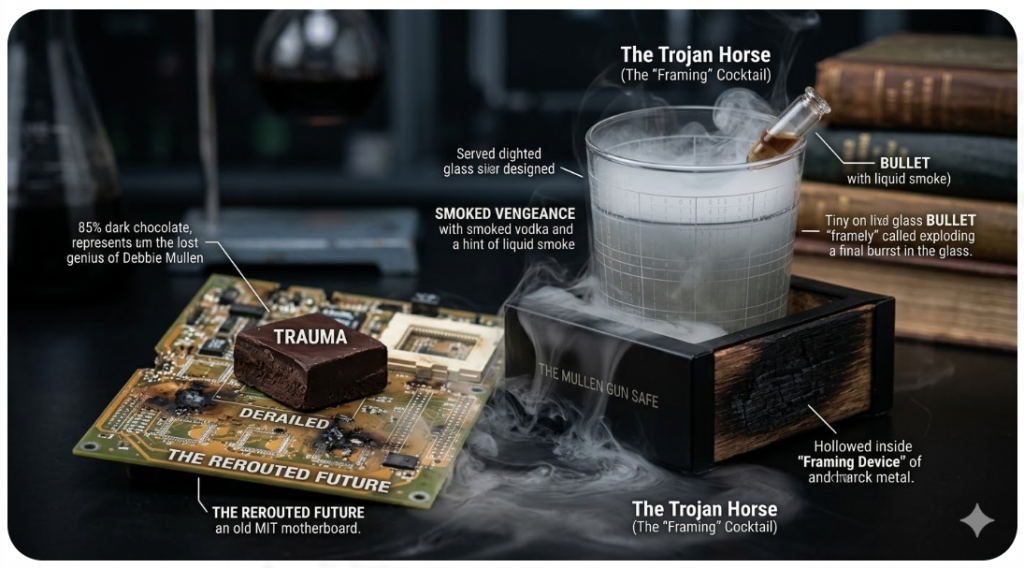
Pairing 3: The MIT Vengeance Protocol
This pairing focuses on the conceptual theme of “Rage and Vengeance,” honoring Debbie’s identity as “the next Bill Gates” of social execution.
The Food: “The Rerouted Future” Dark Chocolate A single, massive piece of 85% Dark Chocolate, serve on a physical, fractured computer circuit board (from an old MIT motherboard). The chocolate is dense, bitter, and labeled “TRAUMA” and “DERAILED.” It represents the academic genius and the potential she lost when she was raped.
The Drink: The Trojan Horse (The “Framing” Cocktail) Served in a clear, modern glass designed like a digital code screen. The base is an “MIT Spirit” (a clean, clear vodka), mixed with “Smoked Vengeance” (liquid smoke, creating an opaque, cloudy grey liquid). It is served inside a hollowed-out “Framing Device” made of dark, charred wood and metal. When the drink is poured, it releases a cloud of literal smoke (representing the Ken Bryant execution). A tiny, stylized glass “Bullet” (labeled “THE GUN S SAFE”) containing the main ingredient (the smoke) is added, which “framely” explodes the smoke in the glass. This is the moment Debbie finally executes her code against Hutch.
The third pairing, seen in Image 6, visualizes “The MIT Vengeance Protocol.” The provided image meticulously adheres to the description: the dense, bitter 85% dark chocolate (labeled “TRAUMA”) is served directly on a physical, scorched “REROUTED FUTURE” computer circuit board from an old MIT motherboard.
“The Trojan Horse” (Image 6) is equally specific. It is a cloudy, smoked vodka and liquid smoke cocktail served in a modern, code-grid glass. The unique element is that the glass is served inside a hollowed-out “FRAMING DEVICE” made of charred wood and metal. When the drink is poured, it releases a cloud of literal smoke (as seen in the image). The final “code execution” is shown with the tiny, stylized “BULLET” (labeled “THE GUN S SAFE”), which contains the smoke and is ready to “framely” explode the main ingredient in the glass. It perfectly captures the clinical precision of Debbie’s revenge.
Bookclub questions
I. The Big Reveal: Initial Reactions
Broad thoughts on the pacing and the “McFadden” effect.
The Identity Swap: McFadden is the queen of the “hidden identity” twist. Were you genuinely blindsided when the man in Harley’s bed was revealed to be Jesse/Hutch instead of Cooper? Looking back, did you spot any breadcrumbs?
The POV Battle: Between the meticulous Debbie, the secretive Cooper, and the delusional Harley, which perspective hooked you the most? Whose “truth” did you trust the least?
The McFadden Universe: If you’ve read The Housemaid or The Boyfriend, how does Debbie stack up against those protagonists? Do you think McFadden is evolving the “unreliable housewife” trope, or is this a classic return to form?
II. Reflection: Mirroring the Mullens
Connecting the dark fiction to our own (hopefully) less-violent realities.
The “Stagnation” Trigger: Debbie’s descent starts with a feeling of being stalled and under-stimulated. Have you ever felt like your potential was being wasted in a “default” role? How did you pivot without, you know, sabotaging a neighbor’s garden?
The Relationship Maze: Harley’s desperation for stability leads her into a trap. Looking at the modern dating landscape, do you think her vulnerability is a common byproduct of the “monogamy at any cost” pressure?
The Weight of Silence: Debbie and Cooper’s marriage is built on two very different types of silence. In your experience, which is more corrosive: a secret about who you are (like Cooper’s addiction) or a secret about what you’ve done (like Debbie’s vengeance)?
Seeking Counsel: The “Dear Debbie” column is the backbone of the book. Why do you think we are so drawn to anonymous advice? If you had a dilemma today, would you trust a “Debbie,” a subreddit, or a therapist?
III. The World Around Us: Cultural Context
Analyzing the “Hingham” social climate.
The Policing of Women: From Coach Pike’s locker room comments to Zane’s extortion, the book is heavy with the “policing” of female bodies. How accurately do you think this reflects the current conversations around misogyny and the “male gaze”?
Digital Surveillance: The Findly app is a major plot driver. Does the ability to track our loved ones 24/7 make us safer, or does it just give us more tools to be toxic? How would this story have ended in a pre-smartphone era?
Generational Romance: Compare Lexi’s high school drama with Harley’s adult pursuit of “Cooper.” Is the core of the struggle—the desire for validation and the fear of exploitation—the same regardless of age?
IV. Deep Dive: Literary Mechanics
Deconstructing how the story was built.
The “Draft” Structure: What did you think of the discarded advice column drafts? I personally felt they were the “true” narrative. How did those snippets change your opinion of Debbie’s morality?
Evolution or Escalation?: Does Debbie actually grow as a person? By the epilogue, has she “healed,” or has she simply become more efficient at hiding her darker instincts?
The Suburban Trap: Setting this in a posh Boston suburb isn’t a coincidence. How does the pressure of “keeping up appearances” serve as a pressure cooker for the plot?
Weaponized Rage: Every character in this book is angry. Who do you think used their anger most effectively, and who was destroyed by it?
Genre Play: Domestic thrillers usually feature a victimized wife. How does McFadden subvert this by making Debbie the smartest (and arguably most dangerous) person in every room?
V. Creative Workshop: Beyond the Page
Taking the story a step further.
The Casting Couch: If this gets a Netflix adaptation tomorrow, who are your “Big Three”? (I’m seeing a Rosamund Pike vibe for Debbie—what about you?)
The Sequel Pitch: The book ends with a “happy” marriage and a secret murder. In your mind, what is the next “code” Debbie has to write? Does Jesse’s death in prison truly end the cycle?
Your Turn at the Desk: Pick one of the reader letters from the book. If you were writing the real published response—not the violent draft or the fake polite one—what would you actually say to them?
Book Review Trail
Dear Debbie
Freida McFadden · 2026
⚠ Full SpoilersWhat to read next


The First Time I Saw Him

The Lost Heiress
You May Also Like

One Last Rainy Day: The Legacy of a Prince
August 26, 2023
The Midnight Feast
September 12, 2024